
- All
- Product Name
- Product Keyword
- Product Model
- Product Summary
- Product Description
- Multi Field Search
Views: 0 Author: Site Editor Publish Time: 2026-10-16 Origin: Site


In large-scale fruit processing plants, raw pineapples present a costly economic paradox: while consumer demand for sliced rings, canned chunks, and dehydrated snacks continues to surge, industrial peeling and coring historically suffer from some of the highest product loss margins in food manufacturing. A conventional manual trimming line routinely sacrifices between 45% and 55% of fruit weight to waste peels, uncentered coring tears, and excessive juice leakage caused by compression dullness. Developed by Fuma Food Machinery, this engineering analysis breaks down the mechanical kinematics of automated concentric peeling, core separation, and uniform ring cutting—delivering verified recovery gains without compromising fruit tissue integrity.

1. The Anatomy of Fruit Waste: Why Pineapples Challenge Conventional Cutting
Processing whole pineapples (such as Queen, MD2, and Smooth Cayenne cultivars) involves navigating three conflicting structural characteristics: a dense, highly acidic parenchyma tissue (pH 3.2–4.0), a tough outer pericarp dotted with deep spiral carpel eyes, and an inner central vascular core measuring between 20 mm and 30 mm in diameter.
Because raw pineapples naturally exhibit curvature or taper from base to crown, manual knives or unguided pushers drift off-center. When the coring tool enters at an angle, it shears valuable edible sweet pulp on one side while leaving woody vascular core fibers on the other, rejecting the entire ring from Grade A canned batches.
Dull or excessively thick cutting dies exert blunt compression rather than clean micro-shear cutting. This crushes fruit cell walls, releasing rich sugars and intracellular moisture (Brix loss). In fresh-cut packaging, this results in rapid liquid pooling in trays; in dehydrators, it causes uneven case hardening.
Pushing an uncleaned pineapple through a cutting die transfers field soil, yeasts, and scale-trapped residues directly into the sterile interior flesh. Automated pre-washing with rotary brush tumblers is required to guarantee clean cuts and safeguard shelf life.
Fuma Food Machinery addresses processing yield challenges through a synchronized continuous preparation flow, replacing labor-intensive bottleneck stations with calibrated mechanical automation:
Raw fruits pass through an intensive bubble-assisted agitation flume paired with contoured spiral brush rollers. High-velocity air jets dislodge surface grit from deep scale crevices without puncturing the rind. Clean washdown ensures that cutting blades do not drag external contaminants into the sweet edible flesh during subsequent incision stages.
Dual parallel circular saw blades trim the top crown and the bottom stem end simultaneously. By creating two flat, perpendicular reference planes on each fruit, the machine establishes a rigid vertical loading axis, preventing the pineapple from wobbling or shifting when transferred into the pneumatic peeling die.
The squared pineapple cylinder sits in a self-centering V-cradle. Powered by a steady 0.7 MPa pneumatic stroke, an outer cylindrical peeling tube and a concentric center core punch descend in perfect co-axial alignment. In one continuous motion:
The solid fruit cylinder enters the continuous rotary slicer. Operating with circular disc knives spaced according to client recipe requirements (adjustable between 3 mm and 15 mm), the machine produces clean, perfectly circular rings at high operational speed, eliminating the jagged, ragged edges typical of reciprocating blades.
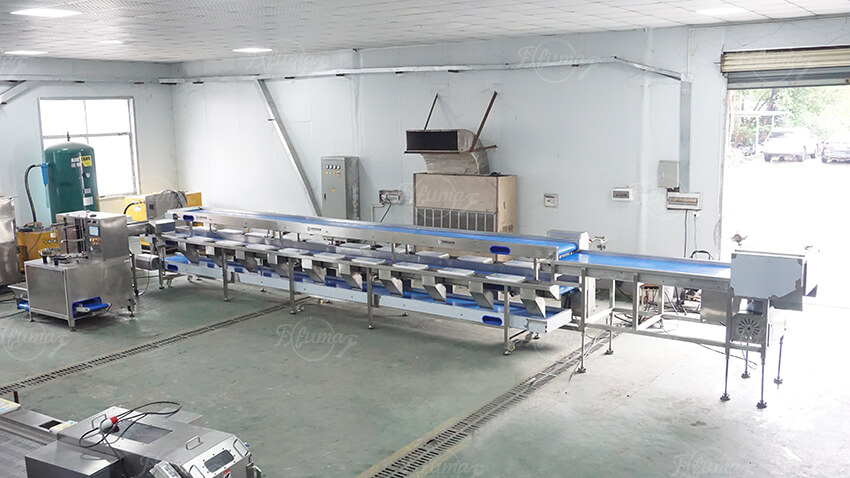
3. Fuma Commercial Machinery Specifications
The following operational specifications reflect verified factory machine data from Fuma Food Machinery's production systems, engineered for continuous commercial duty cycles:
Fuma pineapple lines adapt to varied food processing destinations through interchangeable modular tooling and adjustable mechanical speeds:
Calibrated 10–14 mm slices meet international Grade A syrup clarity standards with zero ragged perimeter fibers.
Clean knife shear limits moisture weeping, preserving visual crispness and extending refrigerated supermarket retail life.
Ultra-uniform 3–5 mm cuts guarantee balanced moisture removal in heat pump drying chambers without leathery zones.
Cored cylindrical logs route into cross-cut sectioning heads to produce uniform diced fruit cubes for frozen toppings.
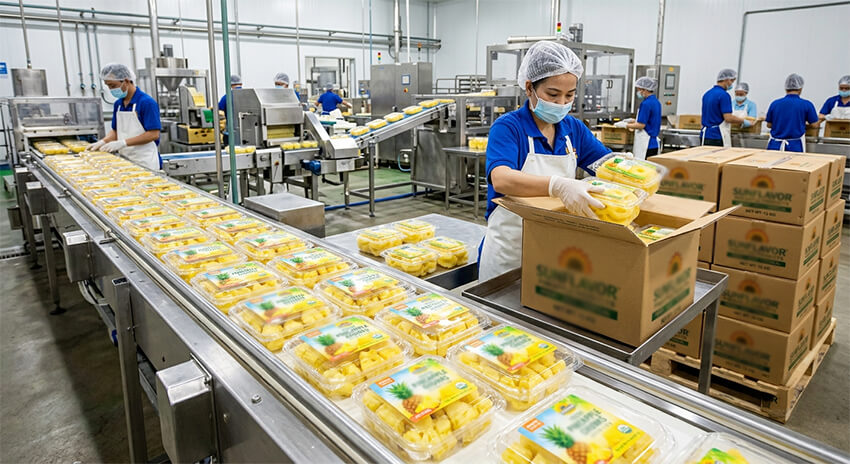
5. Why Food Processors Trust Fuma Machinery
With over two decades of engineering expertise in commercial vegetable and fruit processing equipment, Fuma Food Machinery designs machinery built specifically to withstand aggressive food processing plant environments:
A: Fuma equipment incorporates interchangeable circular peeling cylinders (available in standard diameters including ø 85 mm, ø 95 mm, and ø 105 mm) and inner coring tubes (ø 20 mm, ø 24 mm, ø 28 mm). Operators can rapidly match the tooling to incoming harvest batch dimensions, preventing excessive flesh trimming on smaller fruits.
A: Yes. The automatic rotary ring slicing unit utilizes calibrated knife spacer blocks. Slice thickness is adjustable from 3 mm (for dried fruit flowers) up to 15 mm (for heavy canned rings) without replacing the main drive assembly.
A: The standalone pneumatic peeler and corer requires clean, dry compressed air operating at 0.7 MPa (7 bar) with a volume displacement of 250 L/min. A 4.0 kW to 5.5 kW air compressor with a 24-liter buffer tank satisfies continuous high-cycle operations.
Automatic Pineapple Ring Processing Line (Peeling, Coring, Slicing & Washing)
Pneumatic Pineapple Peeling and Coring Machine (Standalone Workstation)

 WhatsApp