
- All
- Product Name
- Product Keyword
- Product Model
- Product Summary
- Product Description
- Multi Field Search
Views: 0 Author: Site Editor Publish Time: 2025-12-04 Origin: Site


Pineapple is one of the most economically important tropical fruits in global trade, with expanding applications across snack manufacturing, ready-to-eat fruit packs, bakery ingredients, beverages, and canning. As consumption rises, food processors are under pressure to produce higher volumes with better consistency and improved yield.
Reports from international food market analytics platforms such as Statista show that the processed tropical fruit sector continues to grow year after year. This increases the need for automated pineapple processing equipment capable of replacing repetitive manual operations and reducing production bottlenecks.
This article presents a comprehensive technical guide to the equipment used in a full pineapple processing line — covering peeling, coring, cleaning, cutting, and drying — and explains how each system contributes to higher productivity and improved product quality.
Traditional pineapple trimming requires skillful operators but still suffers from common issues such as:
Irregular fruit trimming
Excessive loss of edible fruit flesh
Operator fatigue
Difficulties in maintaining hygiene consistency
Limited throughput during peak production cycles
As noted in the FAO fruit processing guidelines, insufficient control of peeling depth and handling speed directly affects yield, sanitation, and product uniformity — making mechanical equipment essential for scaling production.
 | The automatic peeling machine removes the outer shell and eyes using spiral or contour-following blades. Sensors help compensate for size variation, creating a smooth surface while minimizing excessive trimming loss. |

Stainless steel construction
Adjustable peeling depth
High-speed continuous operation
User-friendly interface
This machine is ideal for plants producing frozen pineapple, fresh-cut packs, or juice ingredients.
 | This machine integrates peeling and coring within a single workstation. Pneumatic actuators apply consistent pressure, producing stable peel thickness and perfectly centered coring results. |

Faster cycle time
Improved fruit integrity
Lower product waste
Better hygiene control
Suitable for medium-to-large processing facilities
By combining two operations, processors can reduce floor space and improve overall workflow efficiency.
After peeling and coring, pineapple surfaces must be cleaned thoroughly to remove remaining eye fragments, peel particles, or knife debris.

This cleaning system uses turbulent bubbles to dislodge impurities while protecting the fruit from mechanical damage. Its recirculating filtration system reduces water consumption and helps maintain hygienic standards.
Processors aiming for compliance with hygienic engineering principles may refer to EHEDG guidelines to better understand how equipment design influences sanitation outcomes.
Optional cleaning line upgrades include ozone water disinfection, automatic sediment removal, and secondary spray systems, especially for export-grade pineapple.
Cutting plays a decisive role in determining final product grade. Different markets require different forms — rings for dehydrated snacks, chunks for canning, slices for bakery applications, and cubes for frozen processing.

The ring cutting unit produces smooth, evenly sliced rings with consistent thickness. Automated versions include conveyor feeding, which stabilizes output quality and allows large-scale production. Manual or semi-automatic models are available for smaller operations.
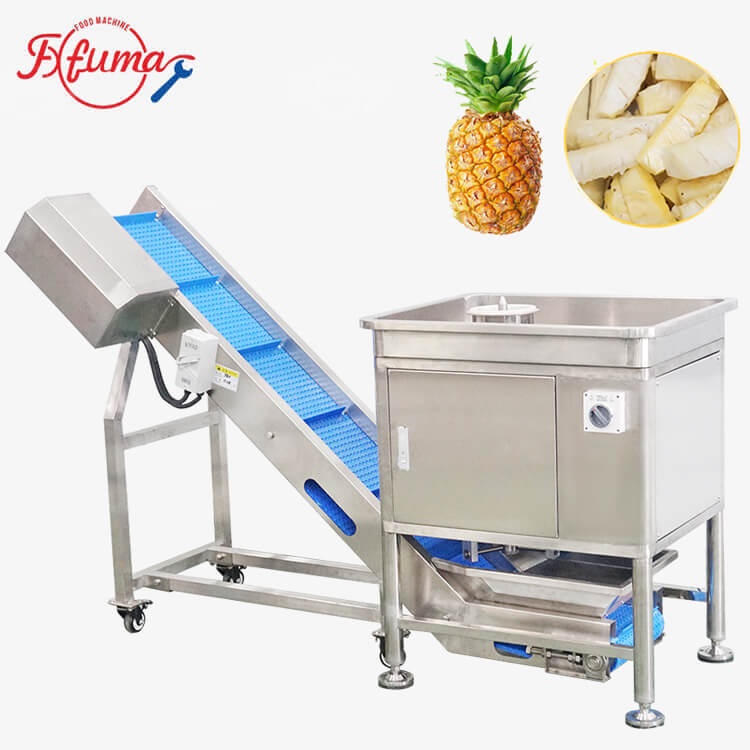 | 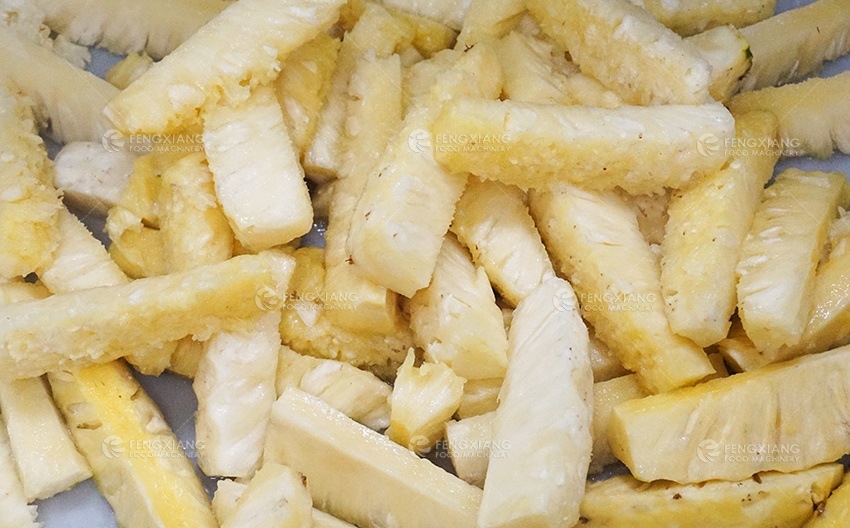 |
Using interchangeable molds, the segmenting system can produce:
4-part wedges
6-part wedges
8-part wedges
Uniform chunks
Pneumatic force ensures stability during the cutting process, preventing fruit breakage and preserving natural shape.
Drying transforms fresh pineapple into long shelf-life products such as dried rings, soft-dried slices, or low-moisture chips. Well-designed drying systems ensure color retention, flavor preservation, and uniform moisture reduction.

This system uses heated, dehydrated airflow to remove moisture gradually. Temperature and humidity curves can be adjusted for different product styles.
For a general technical understanding of food drying dynamics, reference materials such as Engineering Toolbox offer foundational principles on heat transfer and evaporation.
High loading capacity
Even airflow distribution
Optimized energy consumption
Programmable drying cycles
This makes it suitable for continuous or batch drying of rings, chunks, and slices.
Peeling → Coring → Ring Cutting → Drying
Applications: Dried pineapple rings, semi-dried slices, soft-dried fruit snacks
Peeling → Coring → Bubble Washing → Segmenting/Slicing
Applications: Canned fruit, frozen ingredients, bakery fillings, food service products

A Southeast Asian processed fruit factory replaced manual trimming and slicing with a semi-automated pineapple processing line. Within six months, the facility reported:
40% yield improvement
60% labor cost reduction
Consistent cut geometry suitable for export
Cleaner operation with fewer contamination events
Full range of machines: peeling, coring, cleaning, cutting, drying
Scalable: small plants → industrial factories
Designed for hygiene and easy maintenance
Custom layout service
Reliable after-sales technical support
Long-term spare parts availability
Automated pineapple processing offers measurable ROI by reducing waste, increasing yield, improving product quality, and supporting continuous production. From peeling to drying, each machine plays a critical role in building an efficient and profitable production line.

 WhatsApp